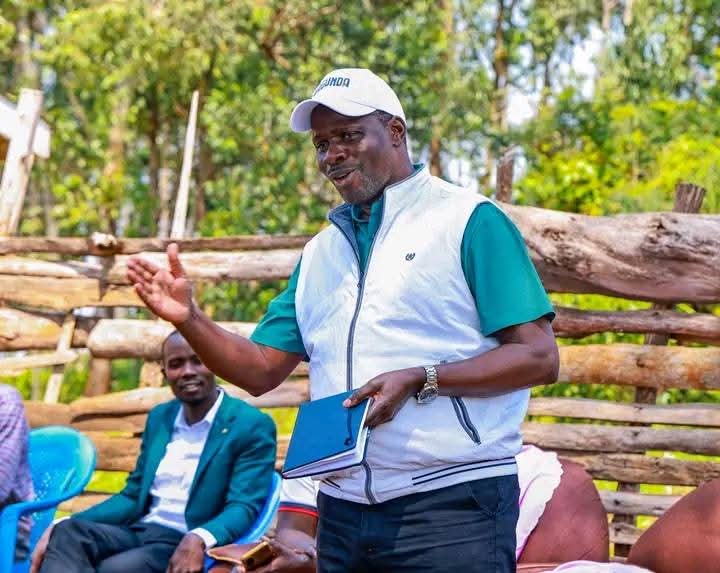
The push to take the government’s development agenda to the grassroots took centre stage at Radienya Comprehensive School in Kwa Ward, Suna East Constituency, where opinion leaders, boda boda operators, youth groups and women representatives gathered for a wide-ranging engagement on development and livelihoods.
The meeting provided a platform for grassroots voices to interact directly on the progress of programmes, projects and initiatives being implemented by the Kenya Kwanza administration, with discussions focusing on how government interventions can translate into tangible improvements in the lives of ordinary citizens.
The engagement underscored the growing importance of community-level participation in the implementation of national development programmes, particularly in constituencies where young people, women and informal-sector workers form a significant part of the local economy.
Rather than limiting the discussion to government projects, the gathering brought together groups with different interests and experiences, creating an opportunity to examine how development policies are being experienced at the community level.
Opinion leaders were able to raise issues affecting their communities, while boda boda operators brought the perspective of one of the country’s most important informal economic sectors. Youth groups and women representatives, meanwhile, provided an avenue for discussions around opportunities, empowerment and household livelihoods.
The engagement also placed particular emphasis on the government’s Bottom-Up Economic Transformation Agenda, which seeks to position ordinary citizens, particularly those at the bottom of the economic pyramid, at the centre of economic growth and opportunity.
For young people in Suna East, however, economic empowerment is not only about conventional employment opportunities.
Sport and creative talent are increasingly being viewed as potential pathways to livelihoods, particularly for young people who may not have access to formal employment.
It was against this backdrop that footballs were distributed to senior, Under-17 and Under-13 teams during the grassroots engagement.
The initiative, undertaken in partnership with the Kenya Academy of Sports, is intended to support young footballers while strengthening the structures through which sporting talent can be identified and nurtured from an early age.

The distribution of the equipment provided a practical dimension to the broader discussions on youth empowerment.
For the youngest players, the Under-13 category offers an opportunity to develop basic skills and interest in the sport. The Under-17 teams provide a platform for young players to progress competitively, while senior teams offer an avenue for more experienced players to continue developing their talent and participating in organised football.
The initiative reflects a broader recognition that sporting facilities and equipment can play an important role in keeping young people engaged in productive activities while helping to identify talent that could eventually develop into professional careers.
The Kenya Academy of Sports partnership also gives the initiative a connection to the country’s broader efforts to develop sports at the grassroots level.
The emphasis is not merely on competition, but on creating an environment in which young people can develop their abilities, maintain healthy lifestyles and potentially convert sporting talent into economic opportunities.
For many young people, football is more than recreation.
It is a source of identity, community and aspiration, with talented players often dreaming of progressing to higher levels of competition.
Providing basic equipment such as footballs can therefore remove one of the practical barriers that grassroots teams face in maintaining regular training and competition.
The initiative also speaks to the creative and sporting economy, an area that has increasingly become part of conversations around youth employment and enterprise.
Under the Bottom-Up Economic Transformation Agenda, the emphasis is on creating opportunities that allow young people to transform their skills and talents into sustainable livelihoods.
At Radienya, that philosophy was brought into a local setting, connecting national policy ambitions with the everyday realities of young people participating in sport.
The broader grassroots engagement also highlighted the importance of maintaining communication between government representatives and communities.
Development programmes ultimately have to be implemented at the local level, where citizens experience their effects directly.
For that reason, conversations involving opinion leaders, women, young people and informal-sector workers can provide valuable insight into the opportunities and challenges facing communities.
The presence of boda boda operators was particularly significant given the role of the sector in providing transport, employment and income for thousands of young people across Kenya.
The sector has become an important part of the local economy, connecting rural communities with trading centres, schools, health facilities and markets.
Women and youth groups, similarly, remain important vehicles through which communities organise around economic empowerment, social development and access to opportunities.
Engaging these groups therefore provides a way of taking the development conversation beyond government offices and into the communities that programmes are ultimately designed to serve.
The Radienya meeting also demonstrated the importance of grassroots ownership of development.
Government programmes can only achieve their intended impact when communities understand them, participate in their implementation and identify opportunities through which they can benefit.
For the organisers of the engagement, the message was clear: development must be accompanied by continuous dialogue with the people it is intended to benefit.
The discussions on Kenya Kwanza programmes and projects were therefore coupled with a practical intervention for young footballers, illustrating how policy conversations can be linked to tangible community initiatives.
The football equipment is expected to help the participating teams continue their training and competitions while providing young players with an opportunity to sharpen their skills.
Beyond the football pitch, the initiative carries a wider message about investing in young people.
With Kenya’s youthful population facing pressure to find employment and sustainable sources of income, interventions that identify and develop skills outside the conventional classroom and workplace can provide additional pathways to economic participation.
Sport can offer some of those pathways, particularly when talent development is combined with coaching, structured competition, education and opportunities for professional progression.
The challenge, however, remains turning grassroots talent into sustainable careers.
That requires continued investment in facilities, coaching, equipment, competitions and talent identification, as well as links between promising athletes and professional opportunities.
The partnership with the Kenya Academy of Sports represents one avenue through which such grassroots development can be strengthened.
At Radienya Comprehensive School, therefore, the engagement brought together two strands of the development conversation: listening to communities and investing in their potential.
The discussions with grassroots groups provided an opportunity to highlight the government’s development agenda, while the distribution of footballs demonstrated a practical commitment to one of the country’s most important resources — its young people.
As the Kenya Kwanza administration continues to promote its Bottom-Up Economic Transformation Agenda, the experience at Kwa Ward illustrates the importance of ensuring that national programmes are accompanied by grassroots engagement.
For the young footballers who received the equipment, the immediate benefit is simple — better access to the tools they need to train and play.
But the longer-term ambition is much bigger: to create an environment in which a young person’s talent, whether in sport, creative arts or another field, can become a source of dignity, opportunity and sustainable income.
The message emerging from Radienya was therefore one of participation, empowerment and opportunity — with the grassroots positioned not merely as recipients of government programmes, but as active participants in shaping and driving the development agenda.
About The Author