
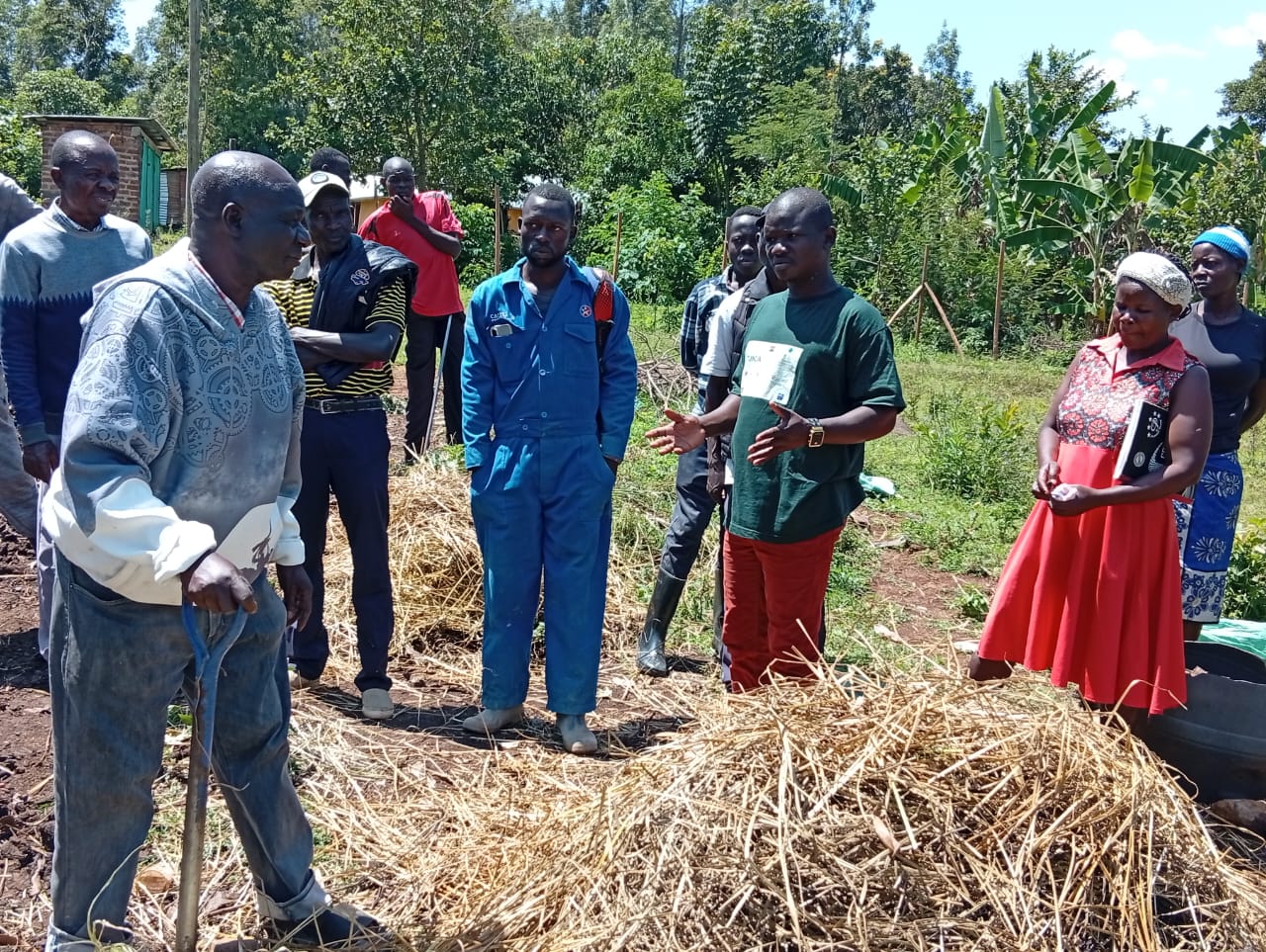
Before the first rains arrive in Migori and parts of western Kenya, the real work on some farms is already under way.
It is not the familiar rush to buy fertiliser, dig planting holes or stock up on seed.
Instead, farmers are being encouraged to walk through their farms with a different set of eyes — looking at the soil beneath their feet, the trees overhead, the insects among the crops, the livestock sheds, water paths and even the weeds that they have spent years trying to eliminate.
The question is no longer simply what will be planted when the rains come.
It is what the entire farm can produce, recycle and regenerate.
This is the thinking behind the growing interest in agroecology and syntropic agriculture in Migori County, where farmers are being encouraged to turn their holdings into interconnected production systems rather than collections of separate crops.
For Mr Benson Opiyo, a lead extension officer with TUNZA a local organisation affiliated to Food amd AgricultureOrganisation (FAO), the transformation begins with a deceptively simple exercise: understanding the farm before attempting to change it.
“Farmers need to look at the farm as one system. The soil, crops, trees, livestock, water, insects and organic matter are interconnected. When you change one component, you affect the others,” Mr Opiyo says.
The philosophy challenges a farming culture in which maize, vegetables, coffee, bananas, livestock and trees are often managed as separate enterprises.

Under agroecology, the farm becomes a web of relationships.
A tree that might previously have been regarded as competing with crops can provide shade, fodder, fruit, firewood, wind protection, biomass or shelter for beneficial insects.
A weed can become mulch, livestock fodder or organic material.
Animal manure can cease to be waste and become a source of soil fertility.
Crop residues can be returned to the soil rather than burned.
It is a quiet revolution, but one with potentially far-reaching consequences for thousands of smallholders.
A different way of looking at coffee
For Mr Caleb Omollo, founder and chair of Sustainable Village Resources, the transformation is particularly relevant to coffee farmers.
Coffee, he argues, does not have to stand alone in the middle of a bare field.
Instead, it can form part of a carefully designed landscape in which bananas, vegetables, legumes, trees and biomass-producing plants perform different functions.
“The coffee farm should be productive beyond the coffee harvest. We need systems where trees, crops, soil, livestock and organic matter support each other,” Mr Omollo says.
It is an idea that challenges the traditional image of a coffee farm as rows upon rows of one crop.
Syntropic agriculture seeks something more complex: diversity arranged with purpose.
The objective is not to throw every available crop into a field and hope they coexist.
Farmers have to understand which plants grow tall, which remain low, how their roots occupy the soil, when they mature, how much water they require and how they compete or complement one another.
Legumes can contribute to soil fertility and biomass. Vegetables can provide quick food and income. Trees can provide shade and organic material. Bananas can offer food and income while coffee develops.
The result is a farm with several layers and several sources of value.
“The objective is planned diversity, not random diversity,” Mr Opiyo says.
The soil comes first
But beneath the crops lies what may be the most important component of the system — the soil.
For years, soil preparation has often been reduced to digging planting holes and applying fertiliser.
Agroecology starts somewhere else.
It treats soil as a living ecosystem containing organic matter, microorganisms, roots, insects and other organisms that support plant growth and nutrient cycling.
Farmers are consequently being encouraged to cover bare soil, retain crop residues, apply compost and mulch, use cover crops and minimise unnecessary disturbance.
The reasoning is straightforward.

Bare soil is exposed to erosion and moisture loss. Heavy rain can carry away topsoil and nutrients, while prolonged sunshine can dry the ground.
Keeping the soil covered therefore becomes as important as planting the crop itself.
“Before farmers ask what fertiliser they are going to apply, they should ask what they are doing to build and protect their soil,” says Mr Opiyo.
This is where syntropic agriculture’s emphasis on biomass becomes important.
Branches and leaves produced through strategic pruning can be cut and placed back on the soil.
Crop residues can remain on the farm.
Organic material can be transformed into compost.
Instead of treating the farm as a place where nutrients are constantly imported and eventually lost, farmers are encouraged to create a cycle in which nutrients move from soil to plants, animals and residues, and eventually back into the soil.
Turning waste into wealth
For a farmer struggling with rising production costs, the idea carries an obvious attraction.
What looks like waste may already be an agricultural input.
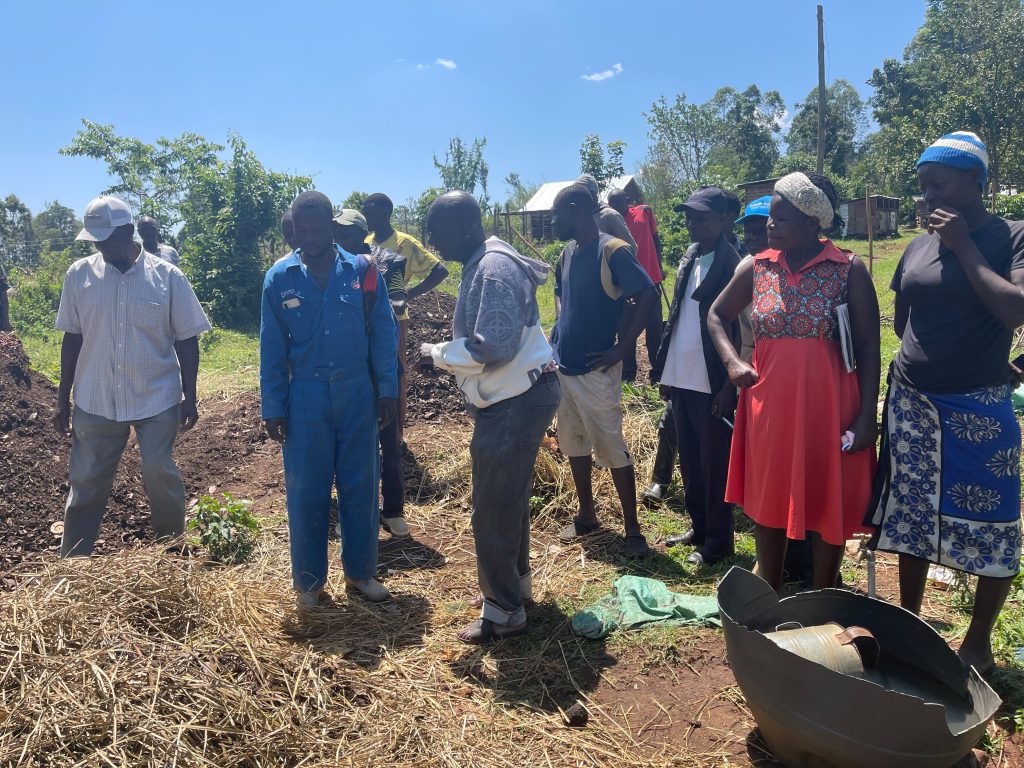
Grass, leaves, crop residues and animal manure can be carefully managed and converted into compost.
But extension officers caution that composting is more than simply piling waste in a corner.
Organic material has to be properly managed to ensure effective decomposition while reducing contamination, nutrient loss and health risks.
For Mr Omollo, such practices are central to the regenerative farming model being promoted through Sustainable Village Resources.
A farm can, in effect, begin feeding itself.
Crop residues can provide livestock feed or organic material. Livestock provide manure. Manure returns nutrients to the soil. Trees and other vegetation provide biomass.
The cycle continues.

Trees are finding their way back
Perhaps nowhere is the shift in thinking more visible than in the treatment of trees.
For generations, farmers have sometimes removed trees from cropland because they were considered competitors for sunlight, water and nutrients.
Syntropic agriculture asks a different question: What can the tree contribute?
A carefully selected tree can provide shade, fruit, fodder, fuelwood, wind protection, biomass and habitat for birds and insects.
In coffee systems, appropriate shade trees can form part of a diversified production landscape.
But this does not mean allowing vegetation to grow unchecked.
Spacing matters.
Species matter.
Pruning matters.
Water competition matters.
Strategic pruning allows farmers to control shade while producing valuable biomass that can be returned to the soil.
The tree therefore becomes part of the production system rather than an enemy of it.
Not every insect is an enemy
The same change in perspective applies to insects.
A farmer accustomed to viewing insects as threats may instinctively reach for pesticides.
Agroecology calls for observation first.
Some insects prey on crop pests. Flowers attract pollinators. Birds contribute to ecological balance. Microorganisms break down organic matter and facilitate nutrient cycling.
The farm is alive with workers that cannot be seen in the same way as a coffee tree or a maize plant.
The challenge is to understand them.
Mr Opiyo says farmers need to distinguish between organisms that damage crops and those that contribute to ecological balance.
Such knowledge can reduce unnecessary chemical interventions while allowing farmers to harness natural processes.
Capturing every drop
Then there is water.
With weather patterns becoming increasingly unpredictable, farmers are being urged to understand not only how much rain falls but what happens to every drop once it reaches the farm.
Where does water enter?
Where does it accumulate?
Where does it run off?
Which areas dry out quickly?
Which parts of the farm are vulnerable to erosion?
These observations can influence where crops and trees are planted.
Mulching and soil cover can improve moisture retention, while rainwater harvesting can help farmers capture water that would otherwise run off the holding.
The aim is to turn rainfall from a temporary event into a resource retained within the farm system.
Livestock complete the circle
In the agroecological farm, livestock also have a role beyond producing meat, milk and eggs.
Cattle, goats, sheep and poultry generate manure, which can become an important source of organic nutrients.
But livestock must also be managed properly.
Animal housing, feeding, water, disease control and manure handling all matter.
When properly integrated, livestock can help close the nutrient cycle: crops provide residues and fodder, animals produce manure, and that manure returns to the soil.
The farm begins to resemble a circular economy on a small scale.
Food before everything else
For Mr Omollo and other proponents of diversification, the ultimate measure of a successful farm should not be the amount of one commercial crop it produces.
It should also be whether the household can eat.
Farmers can reserve space for vegetables, legumes, fruits and other nutritious crops while maintaining commercial enterprises such as coffee.
Short-cycle vegetables and African leafy vegetables can provide food and income while coffee and trees take longer to mature.
This gives households several food and income streams instead of leaving them entirely dependent on one harvest.
Drawing the farm before planting it
One of the simplest lessons emerging from the Agro-Ecological System Analysis approach is also among the most practical: draw the farm.
Before the rains, farmers can sketch their holdings and identify coffee plots, food crops, trees, livestock housing, water points, composting areas, pathways, erosion-prone sections, vegetable gardens, storage facilities and portions of land that need rehabilitation.
The exercise may appear basic.
But it can reveal problems and opportunities that are easily missed when farmers make decisions crop by crop.
It can also help them plan several seasons ahead.
Crop rotation, for example, can reduce pest and disease build-up and improve soil nutrient management.
Instead of repeatedly planting the same crop in one location, farmers can plan sequences involving cereals, legumes, vegetables and cover crops.
The farmer remains the expert
The transition is not expected to be driven by extension officers alone.
Farmer groups can become laboratories for experimentation and learning.
Through Farmer Family Learning Groups, farmers can walk through each other’s holdings, compare practices, observe what works and test different combinations of crops.
The experts bring technical knowledge.
But the farmer brings something equally valuable — intimate knowledge of the land.
“The person who knows a farm best is often the farmer who works on it every day,” the approach emphasises.
This makes farmer-led observation and experimentation an important part of the transition.

The race against the rains
With the planting season approaching, the message from extension officers is that farmers should not wait for the first rains before beginning preparations.
The work should start now.
Map the farm.
Assess the soil.
Prepare compost.
Collect biomass.
Plan crop combinations.
Protect the soil.
Select trees carefully.
Study water movement.
Review livestock systems.
Secure quality planting material.
Identify markets.
Keep records.
For coffee farmers in Migori, the potential prize is a production system that delivers more than coffee.
It can provide bananas, vegetables, legumes, fruits, livestock products, biomass and improved soil — while coffee remains the principal cash crop.
But the transition cannot succeed on ecological principles alone.
Farmers need reliable markets, quality seedlings, extension support, processing facilities and fair prices. If regenerative farming is to become a lasting livelihood strategy, the market must reward both quality and responsible stewardship of the land.
For Mr Omollo, this is where the conversation about syntropic agriculture ultimately leads — beyond farming techniques to the future of rural livelihoods.
For Mr Opiyo, the starting point remains the same: observe, understand and work with the farm rather than against it.
As the clouds gather over Migori and farmers prepare to put their seeds into the ground, the most important question may therefore not be what crop comes next.
It may be what happens when everything on the farm begins working together.
The coffee tree.
The banana.
The legume.
The shade tree.
The livestock.
The compost.
The insects.
The water.
And, at the centre of it all, the farmer.
That is the promise of syntropic agriculture — not merely to grow more crops, but to rebuild the farm as a living system capable of producing food and income while restoring the soil on which future harvests depend.
About The Author


