
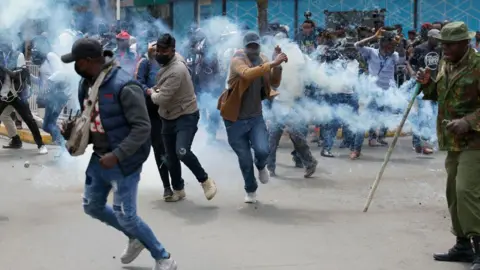
The blood spilled in Kisii last Friday is more than another tragic statistic. It is an ominous warning.
A political convoy associated with the Linda Mwananchi brigade came under violent attack at Keumbu trading center as they made their way to Keroka town.
By the time the dust settled, Vincent Mapinduzi, a Kenyan was dead, several others had been injured, vehicles lay damaged, businesses had shut their doors in fear, and yet another family had begun the painful journey of burying a loved one whose only “crime” was finding himself caught in Kenya’s poisonous politics.
This was not merely an attack on politicians.
It was an attack on democracy.
And unless the State acts swiftly and decisively, it may well be the first of many as the country inches towards the 2027 General Election.
For far too long, Kenya has perfected the dangerous habit of treating political violence as seasonal.
Every election cycle follows an almost identical script. Political temperatures rise. Gangs emerge from the shadows. Convoys are stoned. Rallies are invaded. Supporters clash. Innocent lives are lost. Politicians exchange accusations. Security agencies promise investigations. Then the nation moves on, leaving justice buried alongside the victims.
It is a cycle of impunity that has become as predictable as the elections themselves.
Have we learnt nothing?
The ghosts of the 1992 and 1997 ethnic clashes still linger. The wounds of the 2007–2008 post-election violence have not fully healed. More than 1,000 Kenyans lost their lives, hundreds of thousands were displaced, businesses crumbled and neighbours turned against neighbours. The promise after that national tragedy was simple: Never Again.
Yet, every election season, “Never Again” quietly becomes “Here We Go Again.”
That is a national disgrace.
Political hooliganism has become a thriving industry. Young people are recruited, armed with crude weapons, intoxicated with political slogans and unleashed against fellow Kenyans. After the violence, the politicians who incited them return to air-conditioned boardrooms, negotiate alliances and shake hands for television cameras. The hired gangs are abandoned to prison cells, hospital beds—or graves.
This shameful business model must be dismantled.
Kenya cannot claim to be a mature democracy while political competition is settled through intimidation, machetes, stones and bloodshed. Leadership is earned through ideas, policies and the ballot—not through terror.
The Constitution guarantees every Kenyan the freedom to campaign, assemble and express political opinions without fear. Those rights are not optional. They are not privileges granted by political opponents. They are constitutional guarantees that the State has a duty to protect.
Which brings us to the most troubling question of all.
Where were the security agencies?
How does a political convoy come under sustained attack in broad daylight? How do armed gangs mobilize, organize and execute violence without detection? How many more intelligence failures must Kenyans endure before someone accepts responsibility?
The Ministry of Interior and the country’s security leadership owe Kenyans more than routine condemnations and promises of investigations.
They owe the nation results.
If those entrusted with safeguarding public order cannot guarantee the safety of citizens attending lawful political meetings, then they must seriously reflect on whether they still command the confidence required to hold office. In every functioning democracy, repeated security failures attract political accountability. Kenya should not be the exception.
But accountability cannot stop at the top.
The National Police Service, the Directorate of Criminal Investigations and the Office of the Director of Public Prosecutions must immediately identify, arrest and prosecute every single person involved in the Kisii attack—not only those who hurled stones, but also the financiers, planners, mobilisers and political sponsors who hide behind hired gangs.
Political violence is not campaign strategy.
It is organized criminality.
Those responsible should face the full weight of the law, regardless of their political status, ethnic affiliation or financial influence. The era of sacred cows must end.
Equally, politicians across the divide must stop speaking the language of peace while quietly financing violence. The political class cannot condemn hooliganism in Nairobi while sponsoring it in Kisii, Nakuru, Migori, Mombasa or Eldoret.
Kenyans are no longer fooled by scripted press conferences delivered after blood has already been spilled.
The silence of political parties is equally deafening. Every party must publicly discipline members linked to violence and permanently expel those who sponsor criminal gangs. A party that protects violent actors forfeits the moral authority to speak about democracy.
The clock is ticking.
The 2027 General Election is no longer a distant event on the political calendar. Campaigns have effectively begun. If the Kisii violence is allowed to fade into yet another unresolved police file, it will send a dangerous message across the country—that violence works, that perpetrators are untouchable, and that politics remains a battlefield rather than a contest of ideas.
That message must never be allowed to stand.
The government must move with urgency. Not tomorrow. Not after another funeral. Not after another convoy is attacked.
Now.
Arrests must be made.
Charges must be filed.
Trials must be fast-tracked.
Convictions must follow where the evidence warrants.
Above all, the financiers of political violence—who are often the invisible architects of these attacks—must be exposed and prosecuted. Kenya has imprisoned enough foot soldiers while allowing the generals to walk free.
The blood spilled in Kisii cries out for justice.
Let it not become the opening chapter of another bloody election season.
History will not judge us by the speeches we made condemning violence. It will judge us by whether we stopped it before it consumed another generation.
Kenya stands at a crossroads. One path leads to peaceful democratic competition. The other leads back to the dark days when elections were synonymous with funerals.
The choice belongs to those in power.
The time for statements is over.
It is time for arrests. It is time for prosecutions. It is time for accountability.
Because if political violence is not crushed today, 2027 will not simply be another election—it will be another national tragedy waiting to happen.
The writer is the managing editor-KTMN.CO.KE
byronian4@gmail.com
About The Author