
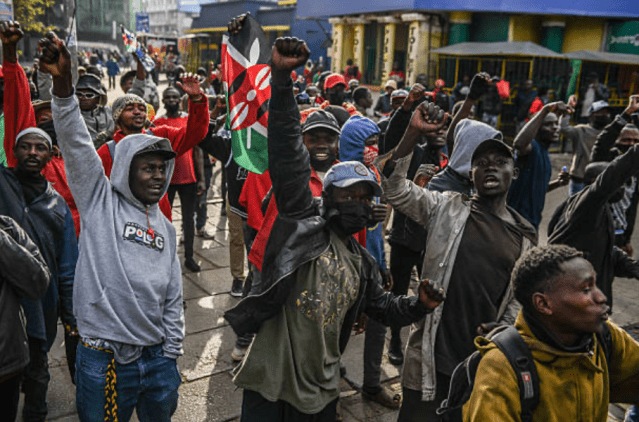
Thirty-five years after the historic Saba Saba uprising shook the foundations of one-party rule in Kenya, Nairobi’s Central Business District once again became the stage for a tense confrontation between protesters demanding constitutional freedoms and security officers determined to prevent public demonstrations.
What was meant to be a symbolic commemoration of one of Kenya’s defining moments in the fight for democracy instead unfolded as a cat-and-mouse game between activists and heavily deployed police officers, culminating in several arrests before the demonstrations could gather momentum.
By dawn, it was clear that the state had resolved to prevent any procession through the capital.
Scores of uniformed and plainclothes officers had already taken strategic positions across Nairobi’s CBD, with anti-riot police, patrol vehicles and security personnel stationed at key intersections leading to government offices and Parliament.
The first target was Jevanjee Gardens, the traditional public meeting ground where civil society groups, youth activists and human rights defenders had planned to assemble before marching to Parliament to present a memorandum on governance, accountability and the protection of constitutional rights.
Before participants could congregate, police cordoned off the park, screening anyone attempting to gain access and dispersing small groups that had begun arriving.
Undeterred, organisers quietly shifted the assembly point to Aga Khan Walk, hoping to outmanoeuvre the security operation. But officers quickly moved in once again.
Several protesters were arrested as they attempted to march along Harambee Avenue towards Parliament, with plainclothes officers grabbing demonstrators while uniformed police blocked access to roads leading to government installations.
The arrests effectively disrupted the planned procession before it could begin.
Later in the day, activists regrouped at All Saints Cathedral, a location that has itself become synonymous with Kenya’s democratic struggles dating back to the pro-reform campaigns of the 1990s.
Addressing journalists, organisers condemned what they described as the continued shrinking of civic space.
“The Constitution guarantees every Kenyan the right to assemble, demonstrate and present petitions peacefully and unarmed. What we witnessed today was a blatant violation of those constitutional protections,” one organiser said.
The activists accused police of criminalising peaceful assembly despite prior notifications and insisted that their demonstration was intended to commemorate Kenya’s democratic journey rather than provoke confrontation.
The Saba Saba anniversary carries profound historical significance in Kenya.
On July 7, 1990, opposition leaders led by the late Kenneth Matiba, the late Charles Rubia, and other pro-democracy campaigners called for a public rally demanding the restoration of multiparty democracy under the administration of former President Daniel arap Moi.
Although the government banned the rally, thousands of Kenyans poured into the streets of Nairobi and other towns. The demonstrations were met with overwhelming force as police opened fire, arrested hundreds of activists and detained opposition leaders without trial. Human rights organisations estimated that dozens of people lost their lives while many others were injured during the crackdown.
Yet rather than extinguishing the reform movement, the events of Saba Saba ignited sustained pressure for constitutional change. Two years later, the government repealed Section 2A of the Constitution, ending Kenya’s de jure one-party state and paving the way for the country’s first multiparty elections in nearly three decades.
The spirit of Saba Saba would continue to shape Kenya’s political trajectory, influencing constitutional reforms that culminated in the promulgation of the 2010 Constitution, widely regarded as one of Africa’s most progressive charters for protecting civil liberties and limiting executive power.
This year’s commemoration comes against the backdrop of renewed public agitation over governance, police accountability, youth unemployment, corruption and the rising cost of living. Since the youth-led protests of 2024, civil society organisations have increasingly invoked the legacy of Saba Saba as a reminder that democratic rights were secured through sacrifice and should not be curtailed.
Human rights groups argue that the Constitution under Article 37 expressly guarantees every person the right to assemble, demonstrate, picket and present petitions peacefully and unarmed, insisting that public order should be maintained without suppressing lawful dissent.
Security agencies, however, have maintained that deployments during major demonstrations are necessary to protect lives, property and critical government infrastructure, particularly following previous protests that degenerated into violence and widespread destruction.
As dusk fell over Nairobi, the streets that had been expected to host chants, placards and speeches remained under heavy police guard. But for many of those who gathered, the symbolism of Saba Saba endures.
Thirty-five years after Kenyans first defied state power in pursuit of democracy, the struggle over the meaning of constitutional freedoms—particularly the right to assemble and protest peacefully—continues to define the nation’s political landscape, underscoring the enduring relevance of the movement that changed Kenya forever.
About The Author