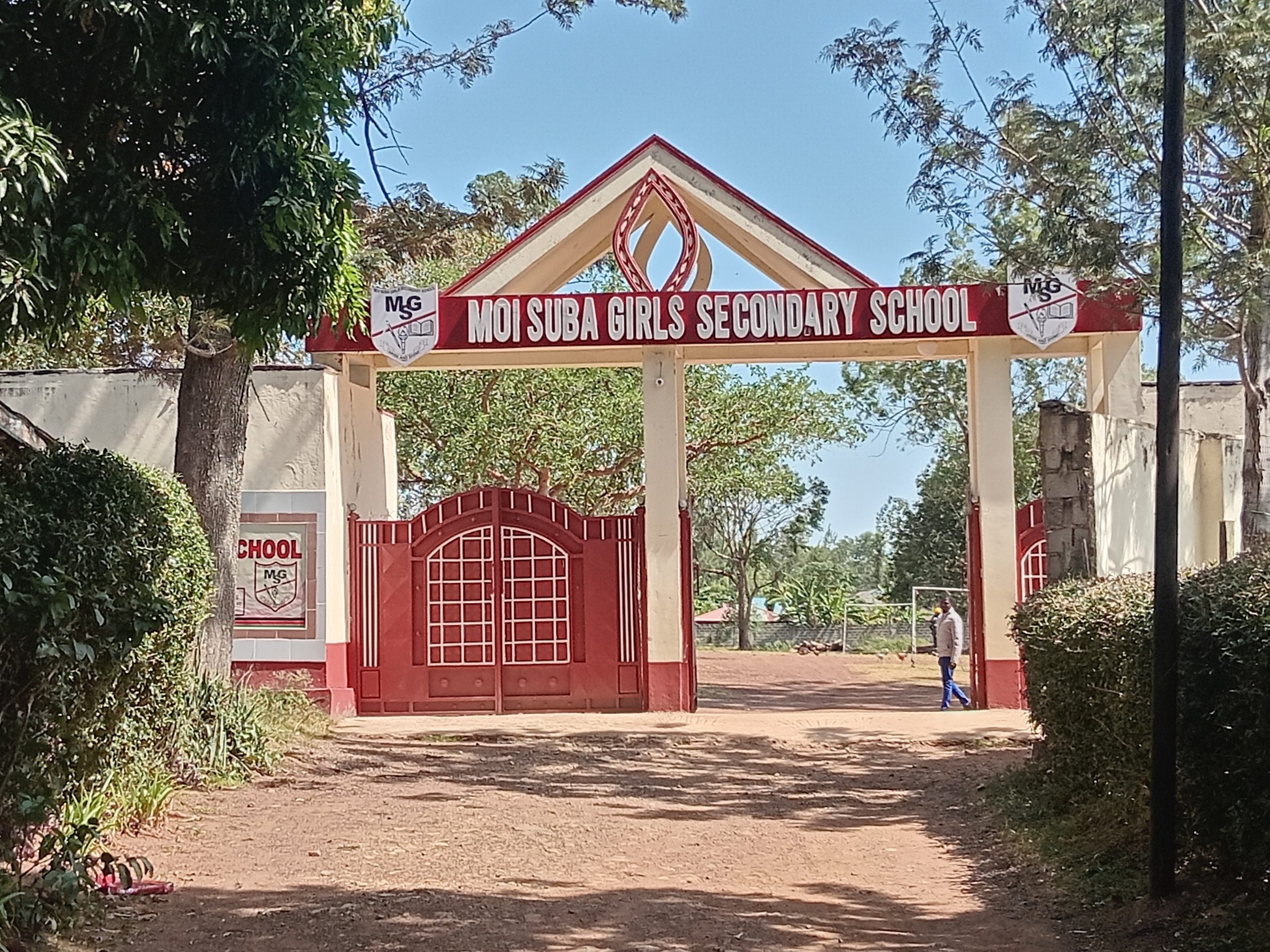
Every morning, as hundreds of girls file through the gates of Moi Suba Girls High School, a cluster 2 category, they carry more than books and dreams.
For some, they also carry an invisible burden—the fear that poverty, not performance, will determine whether they remain in class.
It is a story repeated quietly across Kenya’s public education system, where the constitutional promise of free basic education increasingly collides with shrinking school budgets, mounting operational costs and controversial levies imposed on parents already struggling to survive the tough economy.
An investigation into Moi Suba Girls High School has brought that conflict into sharp focus, raising difficult questions about whether some schools have resorted to charging unauthorized fees to bridge funding gaps, and whether vulnerable learners are paying the highest price.
At the centre of the controversy is Wendy Atieno (not her real name), a Form Three student whose education is fully supported by Jomo Kenyatta Foundation under a government scholarship programme intended to shield children from disadvantaged backgrounds from financial barriers.
Despite the scholarship, Anne found herself locked out of learning after the school recorded an outstanding balance of Sh17,707 on her fee statement.
For the teenager, whose elderly grandmother has been raising her while her mother works in neighbouring Tanzania, the debt was impossible to clear.
Her grandmother insists she believed the government scholarship covered all tuition and boarding expenses.
Instead, the family says they were confronted with additional charges that they neither anticipated nor could afford.
Beyond School Fees
Documents reviewed during the investigation indicate that part of the disputed balance arose from charges described as contributions towards a daily bread programme and repayment of a school bus loan.
Parents interviewed during the investigation said they were expected to contribute Sh1,000 per term towards the bread programme and another termly Sh1,000 for servicing a loan associated with a school bus.
School administrators maintain these were initiatives discussed with parents to improve student welfare and school operations.
However, education experts argue that regardless of the motivation, any compulsory charges imposed outside the fee structures approved by the Ministry of Education raise serious legal and policy questions.
For families living below the poverty line, even seemingly modest contributions accumulate rapidly.
Over the course of four school years, the disputed levies alone could amount to thousands of shillings—money many rural households simply do not have.
In Anne’s case, unpaid balances reportedly accumulated over several terms before culminating in her exclusion from normal classroom learning.
The Law Is Clear
Kenya’s commitment to free basic education is rooted in Article 53(1)(b) of the Constitution, which guarantees every child the right to free and compulsory basic education.
That constitutional guarantee is reinforced by the Basic Education Act, which limits the authority of school administrators and Boards of Management to impose fees beyond those approved by the Cabinet Secretary responsible for education.
Successive Ministry of Education circulars have reiterated that schools should not introduce unauthorized levies or exclude learners from classes because of unpaid charges that fall outside the approved fee structure.
Those directives were introduced after years of complaints that public schools were creating informal payment requirements ranging from infrastructure development funds and remedial tuition charges to meal programmes and transport levies.
While many schools argue that these contributions are necessary to sustain operations amid rising costs, education officials have consistently maintained that compulsory levies undermine equitable access to education.
An Uneasy Admission
When confronted with questions about the disputed charges, Moi Suba Girls Principal Wendy Magara defended the additional contributions as practical measures agreed upon with parents to support services not fully funded by government.
During the interview, she acknowledged that such arrangements could be viewed as inconsistent with official policy, saying:
“I know probably who would say logically those things are not allowed, but maybe practically also, it is another story.”
The remarks illustrate a dilemma confronting many school heads across the country.
Government capitation has frequently been delayed or reduced, while inflation has pushed up the cost of food, transport, utilities and maintenance.
School leaders argue that without additional income, maintaining standards becomes increasingly difficult.
Critics, however, counter that financial pressures cannot justify practices that risk excluding learners or shifting the burden onto families whom government programmes are specifically designed to protect.
Poverty Becomes Punishment
Perhaps the most troubling aspect of the investigation is not the existence of the charges themselves but their impact on children.
Parents interviewed described attending private meetings with school administrators to discuss the outstanding balances.
Several said they felt compelled to make payments despite severe financial hardship because they feared their daughters would be denied an education.
Those unable to pay reported that their children experienced embarrassment and anxiety after being separated from classmates or repeatedly reminded about outstanding balances.
Education rights advocates warn that such practices create two classes of learners inside public schools: those whose families can absorb additional costs and those whose poverty becomes visible every school day.
For scholarship beneficiaries, the contradiction is even more stark.
Government programmes intended to remove financial barriers can be rendered ineffective if schools introduce compulsory charges outside the approved framework.
A Symptom of a National Problem
The controversy at Moi Suba Girls is unlikely to be an isolated incident.
Across Kenya, parents’ associations and education lobby groups have repeatedly raised concerns about unauthorized levies introduced under various descriptions—including development funds, motivational programmes, transport, meals, examinations and infrastructure maintenance.
The issue has persisted despite repeated warnings from the Ministry of Education.
School heads argue that capitation has not kept pace with inflation and that operational budgets are under immense pressure.
Parents, meanwhile, accuse some institutions of passing those costs onto households already grappling with economic hardship.
Education analysts say the resulting tension has created fertile ground for inconsistent practices, with schools interpreting ministry guidelines differently and enforcement varying from one county to another.
Questions That Demand Answers
Following media inquiries, Anne was eventually allowed back into class after discussions with the school.
While that decision resolved her immediate predicament, it leaves broader questions unanswered.
Were the disputed charges voluntary or compulsory?
Were they approved by the relevant authorities?
How many other students accumulated similar balances?
Have other scholarship beneficiaries faced comparable challenges?
And perhaps most importantly, how widespread are such practices across Kenya’s public schools?
These are questions that extend far beyond one institution.
They go to the heart of whether the constitutional promise of free education is being realised in practice or gradually eroded by unofficial costs that disproportionately affect the country’s poorest children.
For thousands of vulnerable learners, the greatest obstacle to education may no longer be the absence of schools.
It may be the hidden price of attending them.
byronian4@gmail.com
About The Author