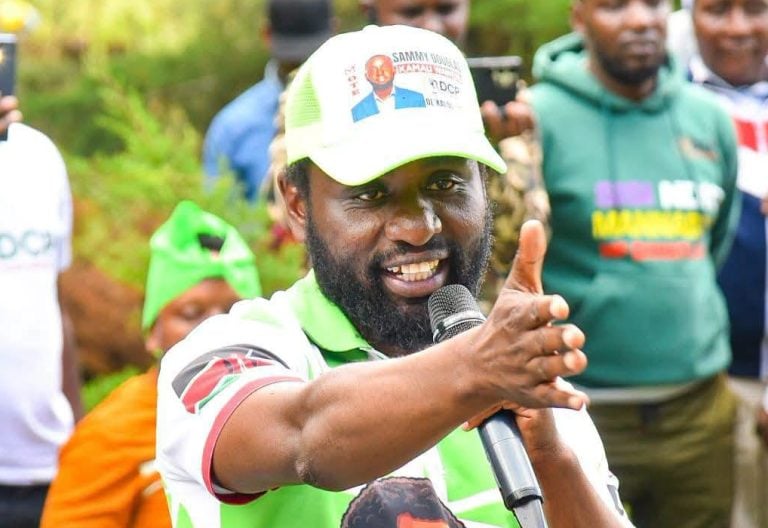
The current verbal insults, mud smearing and copious distortion of political truths and lies drew me to listen to one of my favourite artists, the Zairean crooner and guitar wizard Franco Luambo Luanzo Makiadi, popularly known as “Otoyo” by Luo lovers of his music.
In his song Tailleur-Mokolo Tonga, there is a stanza in Lingala: “Mokolo Tonga, abotali tonga, okotonga na nini ee,” loosely translated to mean, “to the owner of the needle, the needle has been taken away — what will you sew with?”
This was a satirical song composed by Franco as a direct attack on Leon Kengo wa Dondo, the former Zairian Attorney General and Prime Minister.
It was mockery following his fall from power under the Mobutu regime after he imprisoned Franco for previous explicit songs.
This draws me to the aftermath of the impeachment of former Deputy President Rigathi Gachagua and the political aftermath that followed.
It is now over one year since the second Deputy President and former Mathira MP was impeached from his position by both the National Assembly and the Senate.
The man whom many thought would vanish and disappear politically in a “Simon Makonde-like fashion” has instead refused to disappear despite the “political needle” being taken away from him.
The once-acclaimed deputy president, accused by his foes of being a pinchbeck dictator, has retreated to his Wamunyoro home and consolidated a loyal — and at times politically suicidal — support base.
The self-declared truthful man with an acerbic tongue has undergone what can best be described as a Pauline conversion and is now one of the fiercest critics of the regime he vigorously campaigned to bring into power.
In recent weeks, battle lines have sharply emerged between President William Ruto and his former deputy, together with their political allies, who are increasingly mirroring the hostility of their principals.
The verbal exchanges have become fast, furious, and deeply personal whenever political crowds gather.
Both Ruto and Gachagua increasingly present themselves as moralists and puritans despite the yawning gulf between their claims and political realities, especially if recent accusations against each other bear any element of truth.
Many political commentators expected Gachagua to emerge politically wounded and weakened once the “owner of the needle had taken away his needle” or simply vanish altogether.
On the contrary, Gachagua has remained politically relevant and has become a thorn in the flesh of the Ruto administration through sustained political rallies and frequent media interviews.
On Gachagua’s continued relevance, President Ruto appears to have miscalculated — something he rarely does.
Ruto was not Machiavellian enough in his approach.
He did not politically finish Gachagua completely, a blame that partly rests on the shoulders of his advisers if he ever listens to their counsel.
Instead, Ruto only weakened Gachagua while leaving him in a position where he remained dangerous to the regime.
As Niccolò Machiavelli famously put it in The Prince: “You must either pamper people or destroy them; harm them just a little and they will hit back; harm them seriously and they won’t be able to.”
Ruto, it appears, was neither ruthless nor efficient enough.
The fallout between Ruto and Gachagua has deeply polarized the Mount Kenya region, where Gachagua has increasingly found political refuge and sympathy.
Ruto’s popularity in the region appears to have declined, while leaders allied to him — including Moses Kuria, Eric Wamumbi, and Sabina Chege among others — continue facing hostility from sections of their own voters, who increasingly perceive them as political traitors.
A few weeks ago in Thika, some leaders accompanying the President reportedly faced hostile reception from residents. But what truly led to Gachagua’s historic impeachment?
He was accused of several offences including corruption, gross misconduct, and even allegations surrounding questionable business dealings.
However, I strongly hold the view that Gachagua’s impeachment — much like the successful impeachments of former governors Mike Sonko (Nairobi), Ferdinand Waititu (Kiambu), and Kawira Mwangaza (Meru) — was more political than legal.
Gachagua had, in many ways, become too big for his political breeches and therefore had to be cut down to size.
The self-declared “Riggy G” before his impeachment appeared intoxicated with power and suffered from what may be termed the “Icarus Effect,” drawn from Greek mythology.
Like Icarus, Gachagua flew too close to the sun after waxing his wings. He became overexcited and failed to heed the timeless warning against flying too close to dangerous power centers.
He occupied a peculiar arrangement where he wielded office without necessarily possessing corresponding political power.
In the end, he moved too close to the political sun — antagonizing the Kenya Kwanza politburo and the broader political establishment — and his wings melted.
He fell from grace on the floor of both the National Assembly and the Senate.
Since inauguration, Gachagua had effectively been seated atop a pit of political snakes where every wrong move carried potentially fatal consequences.
His parallel press conference in Mombasa in June 2024, shortly after Gen Z protesters stormed Parliament, appeared to become the defining moment many within the establishment had been waiting for.
Gachagua was abrasive and often brutal toward the regime’s perceived enemies. He rattled many political snakes without neutralizing them — from Cabinet colleagues to opposition figures and even his own supporters.
He never fully understood the theoretical or strategic significance of what he had achieved in his meteoric rise from a one-term Member of Parliament and long-serving provincial administrator to the country’s second-highest office.
Like many of his political moves after impeachment — both good and bad — he frequently confused strategy with tactics and tactics with strategy, a mistake that often proves fatal in politics.
As the political rivalry between the two former allies intensifies heading toward the 2027 General Election, more realignments are inevitable in what increasingly resembles a zero-sum contest between rival camps.
Ultimately, the political pendulum may come to rest somewhere in the middle, with ordinary Kenyans once again drawn into elite political maneuvering.
In the fierce battle for the heart and soul of the Kenyan voter — especially in the populous Mount Kenya region — who between Ruto and Gachagua will stab first?
The daggers are already drawn, the spectators are ululating, and 2027 is fast approaching.
History, being Shakespearean in nature, demands only one response for now: let us wait and see.
Mr Ouma is a Political Scientist and Development Researcher.
About The Author