

The Kenya Literature Bureau (KLB), one of East Africa’s oldest and most influential publishing institutions, has unveiled an ambitious five-year strategic roadmap aimed at transforming the organization into a modern, technology-driven publishing powerhouse.
The launch of the Kenya Literature Bureau Strategic Plan 2025–2030, presided over by Principal Secretary Cyril Odede, signaled a renewed commitment by the government to strengthen Kenya’s knowledge economy, modernize public enterprises, and position local publishing institutions to compete in an increasingly digital global marketplace.
Addressing stakeholders during the launch, Odede described the strategic plan as a transformative blueprint that will not only redefine KLB’s future but also contribute significantly to the country’s educational and economic development agenda.
“Today marks a significant milestone in the history of the Kenya Literature Bureau. This strategic plan is more than a policy document; it is a bold statement of intent that charts a clear path toward innovation, growth, and sustainability. It provides a framework through which KLB can harness emerging technologies, expand its reach, and strengthen its role as a custodian of knowledge and learning in Kenya and beyond,” said Odede.
A Legacy Spanning Nearly Eight Decades
Founded in 1947 as the East African Literature Bureau during the colonial era, KLB has played a central role in publishing educational materials, literary works, and government publications across the region.
For generations, the institution has supplied schools with textbooks and learning materials, helping shape the intellectual development of millions of learners in Kenya and neighboring countries.

Odede lauded the institution for surviving and thriving through decades of political, economic, and technological changes.
“Very few institutions can proudly trace their roots back nearly eighty years and still remain relevant. KLB’s resilience is a testament to visionary leadership, dedicated staff, and an unwavering commitment to promoting literacy, education, and access to information. Its journey mirrors Kenya’s own development story,” he noted.
The PS observed that the recent enactment of the Government Owned Enterprises (GOE) Act, 2025, marks a new chapter for KLB, positioning it as a fully-fledged commercial government enterprise under the State Department for Public Investments and Assets Management.
According to Odede, the transition presents an opportunity for the institution to strengthen governance, improve operational efficiency, and unlock new revenue-generating opportunities.
Ambitious Growth Targets
At the heart of the strategic plan is a bold financial growth agenda.
KLB is targeting an increase in gross revenue from Ksh 12.5 billion to Ksh 14.5 billion by the end of the 2029/2030 financial year, driven by diversification of income streams, expansion into emerging markets, enhanced partnerships, and increased investment returns.
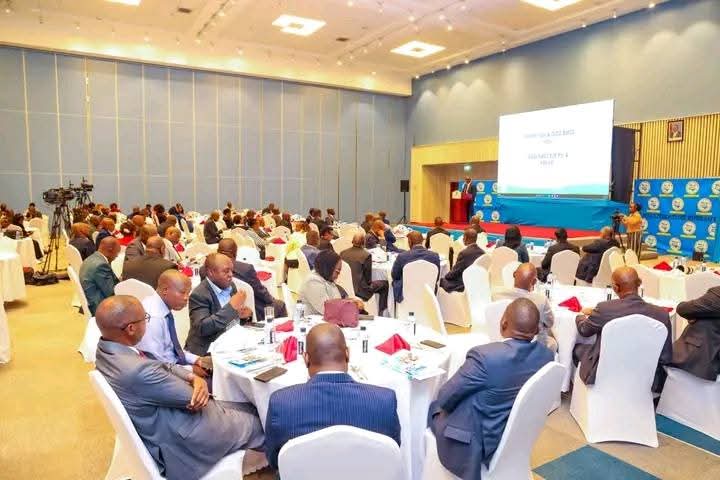
Odede welcomed the ambitious projections, emphasizing that the targets are achievable if supported by innovation and strategic execution.
“The future belongs to institutions that are willing to reinvent themselves. KLB must move beyond traditional publishing models and explore new opportunities in digital publishing, content licensing, educational technologies, strategic investments, and regional expansion. The revenue targets outlined in this plan demonstrate confidence in the institution’s capacity to grow and compete,” he stated.
Artificial Intelligence Takes Centre Stage
One of the most striking aspects of the strategy is KLB’s commitment to embracing emerging technologies, including Artificial Intelligence (AI), to enhance publishing and printing operations.
The institution plans to integrate AI-driven systems into content development, editing, production, and distribution processes while migrating critical operations to secure cloud-based platforms.
Odede said technological adoption will be critical in ensuring that KLB remains competitive in a rapidly evolving publishing landscape.
“The publishing industry is undergoing unprecedented transformation. Artificial Intelligence, cloud computing, data analytics, and automation are reshaping how content is created, distributed, and consumed. KLB must position itself at the forefront of this revolution rather than play catch-up,” he said.
“Technology should not be viewed as a threat but as an enabler that enhances efficiency, reduces operational costs, improves quality, and expands access to educational content.”
Expanding Production Capacity
The strategic plan also outlines plans to increase KLB’s internal production capacity from 3.6 million units to 10 million units, a move expected to strengthen self-sufficiency and reduce reliance on external production processes.
The expansion is projected to enhance the institution’s ability to meet growing demand for educational materials while improving turnaround times and product quality.
Odede challenged the management team to ensure that the planned infrastructure upgrades are implemented without delay.
“Modernization cannot remain a concept on paper. We must see tangible investments in machinery, production facilities, digital systems, and human capital. These reforms will determine whether KLB remains competitive and profitable in the years ahead.”
“Automation of workflows and modernization of infrastructure are no longer optional. They are essential ingredients for institutional sustainability and long-term success.”
Supporting Kenya’s Knowledge Economy
The PS further emphasized that a vibrant publishing sector is critical to Kenya’s ambitions of becoming a knowledge-driven economy.
He noted that publishers play a crucial role in promoting literacy, preserving culture, supporting education, and facilitating innovation.
“Knowledge remains one of the most powerful drivers of economic transformation. Institutions like KLB are not merely publishers; they are nation-builders. They provide the tools through which learners acquire skills, researchers generate solutions, and societies preserve their cultural heritage.”
He added that the strategic plan aligns with the government’s broader agenda of improving public enterprise performance while promoting digital transformation across sectors.

Stakeholders Rally Behind the Vision
The launch attracted key players from the education and publishing sectors, including Eve Obara, Vice Chairperson of the National Assembly Committee on Education, former KLB Board Chairperson Prof. Rispah Wepukhulu, KLB Managing Director George Okeyo, and other stakeholders.
Participants pledged their support for the implementation of the strategic plan, describing it as a timely intervention that will strengthen Kenya’s publishing industry and expand access to quality educational content.
KLB Managing Director George Okeyo reaffirmed the institution’s commitment to delivering on the plan’s objectives.
“This strategic plan reflects our determination to transform KLB into a modern, innovative, and commercially competitive enterprise. We are focused on strengthening our operational capacity, embracing technology, and creating value for both our customers and the government.”
A New Chapter for East Africa’s Oldest Publisher
As KLB approaches its eighth decade of existence, the institution is seeking to reinvent itself for a digital age characterized by rapidly changing reader habits, technological disruption, and increased competition.
For many stakeholders, the launch of the Strategic Plan 2025–2030 represents more than a routine corporate exercise. It is a declaration that one of East Africa’s most historic publishing institutions is preparing to write a new chapter—one defined by innovation, growth, and resilience.
And as PS Cyril Odede concluded in his remarks, the challenge now lies not in drafting ambitious plans but in turning them into measurable results.
“The true measure of this strategic plan will not be found in its pages but in its implementation. If executed faithfully, it will position KLB as a leading knowledge enterprise, create new economic opportunities, and strengthen Kenya’s standing as a regional leader in publishing and innovation.”
About The Author


