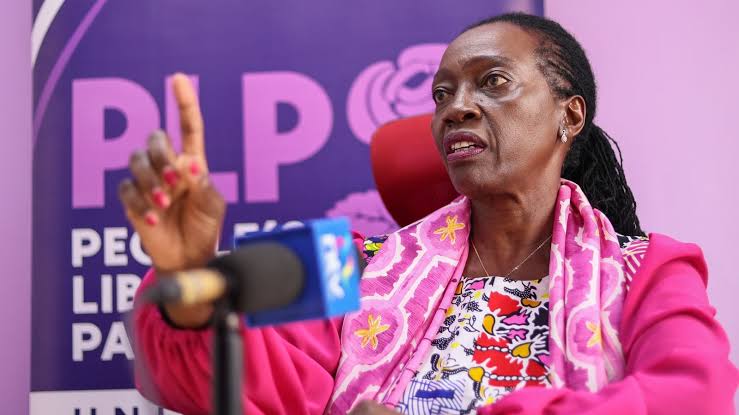
A diplomatic and legal storm is brewing within the East African Community (EAC) following the detention and denial of entry of Kenyan Senior Counsel and People’s Liberation Party (PLP) presidential aspirant Martha Karua by Ugandan authorities at Entebbe International Airport.
The incident, which unfolded on Sunday morning before Karua was later released and allowed to return to Nairobi, has reignited concerns about shrinking democratic space, cross-border legal cooperation, and the state of civil liberties within the region.
According to a statement issued from Karua’s office, the veteran lawyer and former Kenyan Justice Minister was detained upon arrival at Entebbe International Airport despite travelling on legitimate business related to ongoing legal proceedings involving detained Ugandan opposition leader Dr. Kizza Besigye and his co-accused Obeid Lutale.
Karua was reportedly travelling alongside Law Society of Kenya (LSK) President Charles Kanjama to attend a court ruling on a bail application linked to the high-profile case.
While Kanjama was allowed entry into Uganda, Karua was denied access and held by authorities for several hours without immediate communication with her legal team or family.
“Senior Counsel and PLP Presidential Aspirant Martha Karua has been detained at Entebbe International Airport after Ugandan authorities denied her entry into the country,” her office said in an initial statement.
The statement further indicated that Karua remained incommunicado for several hours.
“Her senior team reports that she is unreachable, with her mobile phones switched off, and they continue to await direct communication regarding her status and expected return.”
Legal Representation at the Centre of the Dispute
The detention attracted immediate attention because of Karua’s prominent role in defending Dr. Besigye, one of Uganda’s most influential opposition figures.
Karua has been actively involved in Besigye’s legal battles since late 2024 and is recognized as part of the international legal team representing the veteran opposition leader.
According to her office, she holds a valid legal practising certificate in Uganda through the law firm of Erias Lukwago, Kampala’s former Lord Mayor and a respected human rights lawyer.
The development comes at a sensitive moment in Uganda’s political landscape.
Lukwago himself was recently arrested by Ugandan security agencies and later charged with misprision of treason, allegations linked to the same case facing Besigye.
Political observers argue that Karua’s detention cannot be viewed in isolation from the broader political tensions surrounding the prosecution of Uganda’s opposition figures.
A Career Built on Constitutionalism
Karua is no stranger to high-stakes political and legal battles.
A Senior Counsel in Kenya, she has built a reputation across Africa as a fierce advocate for constitutionalism, judicial independence, and democratic governance.
She previously served as Kenya’s Minister for Justice and Constitutional Affairs and later emerged as one of the country’s most prominent opposition leaders.
In recent years, she has become increasingly active in regional human rights and governance issues, frequently lending legal expertise to politically sensitive cases beyond Kenya’s borders.
Her involvement in the Besigye matter elevated the case into a regional concern, attracting scrutiny from legal bodies, civil society organizations, and democracy advocates across East Africa.
Release and Return to Nairobi
Hours after concerns mounted over her whereabouts, Karua’s office issued an update confirming that she had been released and had departed Uganda.
“We can confirm that Presidential Aspirant and Senior Counsel Martha Karua has departed Entebbe and is en route to Nairobi following her detention and denial of entry by Ugandan authorities earlier today.”
Her office announced that she would address journalists upon arrival at Jomo Kenyatta International Airport.
“Members of the media are invited to a press briefing at JKIA where she will address the circumstances surrounding her detention, denial of entry, and subsequent release.”
The briefing is expected to shed light on what transpired during her detention, whether reasons were formally communicated by Ugandan authorities, and what implications the incident may have for her future participation in legal proceedings in Uganda.
Questions for the East African Community
The incident has already triggered debate among legal experts and political analysts regarding the principles underpinning the East African Community.
One of the EAC’s key objectives is the promotion of free movement of persons, services, and professionals among member states. Karua’s supporters argue that denying entry to a respected advocate involved in a legal matter raises uncomfortable questions about the practical implementation of those commitments.
Her office pointedly framed the incident as a broader governance issue rather than a personal inconvenience.
“The incident raises serious questions about the observance of the rule of law and the state of democratic freedoms within the East African Community.”
Analysts note that relations between state authorities and opposition actors across the region have increasingly come under scrutiny, with concerns frequently raised over political freedoms, civic space, and judicial independence.
Growing Regional Concern
The detention is likely to reverberate beyond Uganda and Kenya, particularly among legal associations, human rights organizations, and democratic governance advocates.
For many observers, the incident highlights a growing tension between regional integration ambitions and concerns over political freedoms.
As East Africa continues to pursue deeper economic and political integration, events such as the detention of a senior advocate travelling on legal business risk undermining confidence in the bloc’s commitment to the rule of law.
With Karua expected to provide a firsthand account of her ordeal, attention now turns to Nairobi and Kampala, where calls for clarification and accountability are likely to intensify.
For a region that has long championed cooperation, free movement, and democratic governance, the questions raised by Martha Karua’s detention may prove difficult to ignore.
About The Author