
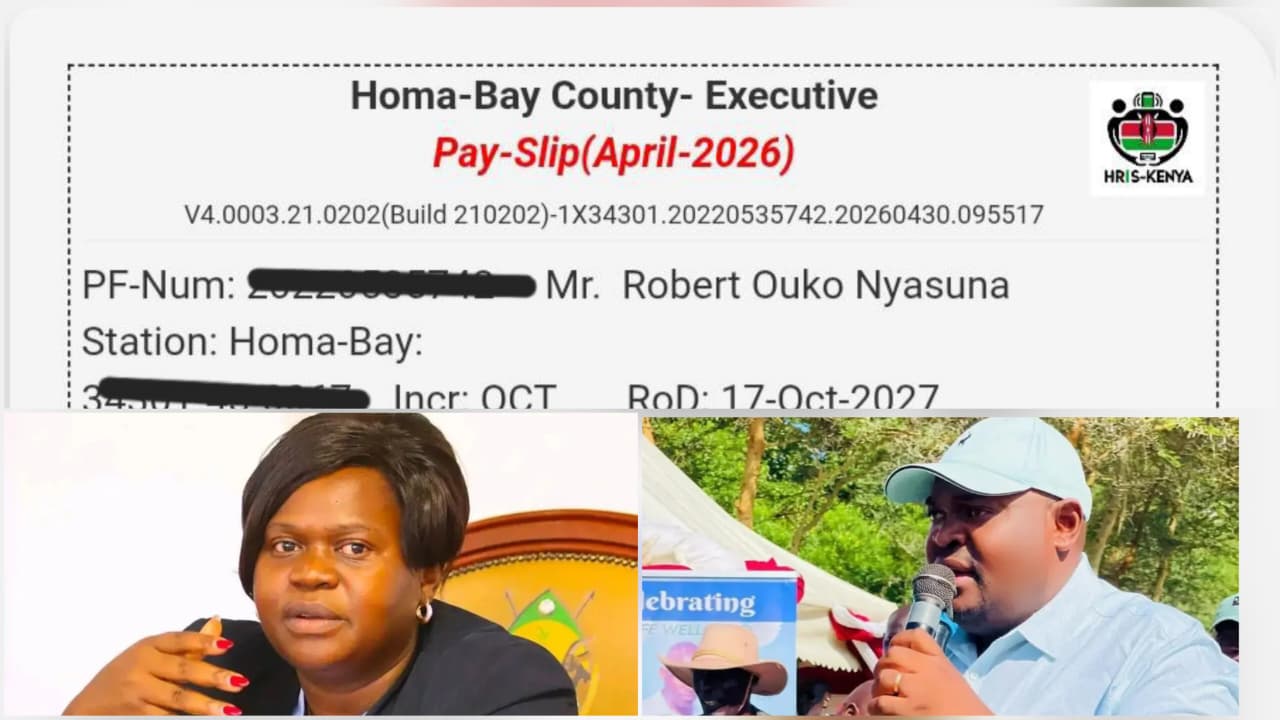
Fresh details have emerged raising questions over alleged irregular payments within the Homa Bay County payroll, with claims that an individual linked to Governor Gladys Wanga continues to receive a salary despite reportedly exiting county employment years ago.
The claims centre on Robert Ouko Nyasuna, said to be the governor’s brother, who in a recent public platform stated that he stepped away from county affairs about three years ago following sustained public scrutiny over his role and eligibility to serve in the devolved unit.
However, verified documents now reviewed by our sources familiar with the matter appear to contradict that position as they show that payments linked to the county government may have continued beyond the stated exit period.
Among the documents cited is an April 2026 payslip attributed to an individual by name Robert Nyasuna, showing a gross salary of Sh187,360.
After statutory and loan deductions, the net pay is indicated at approximately Sh51,000, suggesting continued financial engagement with the county payroll system.
In addition, records associated with the Kenya Revenue Authority for the 2025 tax year reportedly list employment income sourced exclusively from the County Government of Homa Bay, with no indication of alternative sources of earnings during that period.
The apparent discrepancy between public statements and financial records has triggered concern among oversight stakeholders and governance actors, some of whom are now calling for a formal clarification on the matter.
“If indeed an individual disengaged from public service, then continued payments would raise serious accountability questions that require immediate explanation,” said a source familiar with county financial oversight processes, who requested anonymity due to the sensitivity of the issue.
The development comes in the context of earlier efforts by the county administration to streamline its payroll.
Shortly after assuming office, the government engaged PricewaterhouseCoopers (PwC) to undertake a comprehensive payroll audit targeting suspected ghost workers.
At the time, officials indicated that approximately 1,700 irregular entries had been identified for removal as part of broader reforms aimed at restoring fiscal discipline and improving service delivery.
Despite the audit exercise, concerns have persisted regarding the size and sustainability of the county’s wage bill.
Available data indicates that personnel expenditure has risen to about 55 per cent of the total budget, significantly above the 35 per cent ceiling set under public finance management guidelines.
Further claims circulating in governance and civic spaces suggest that the issue may not be limited to a single case.
Allegations have emerged pointing to possible irregular payroll entries linked to individuals and networks beyond the county, including claims involving external actors.
However, these assertions remain unverified and have not been independently confirmed.
Separately, scrutiny has also been directed at the financing of a new county headquarters project.
Initial estimates placed the cost at approximately Sh480 million, but subsequent reports indicate the figure may have risen to about Sh820 million.
The project is said to have been financed through arrangements involving the County Pension Fund, with reports suggesting a long-term repayment structure extending over several decades.
The full details of the financing model, including total repayment obligations, have not been publicly disclosed.
Efforts to obtain comment from the office of Governor on both the payroll concerns and the infrastructure financing questions were unsuccessful by the time of publication.
The county government has yet to issue an official statement addressing the specific allegations or providing clarification on the documents in circulation.
About The Author